
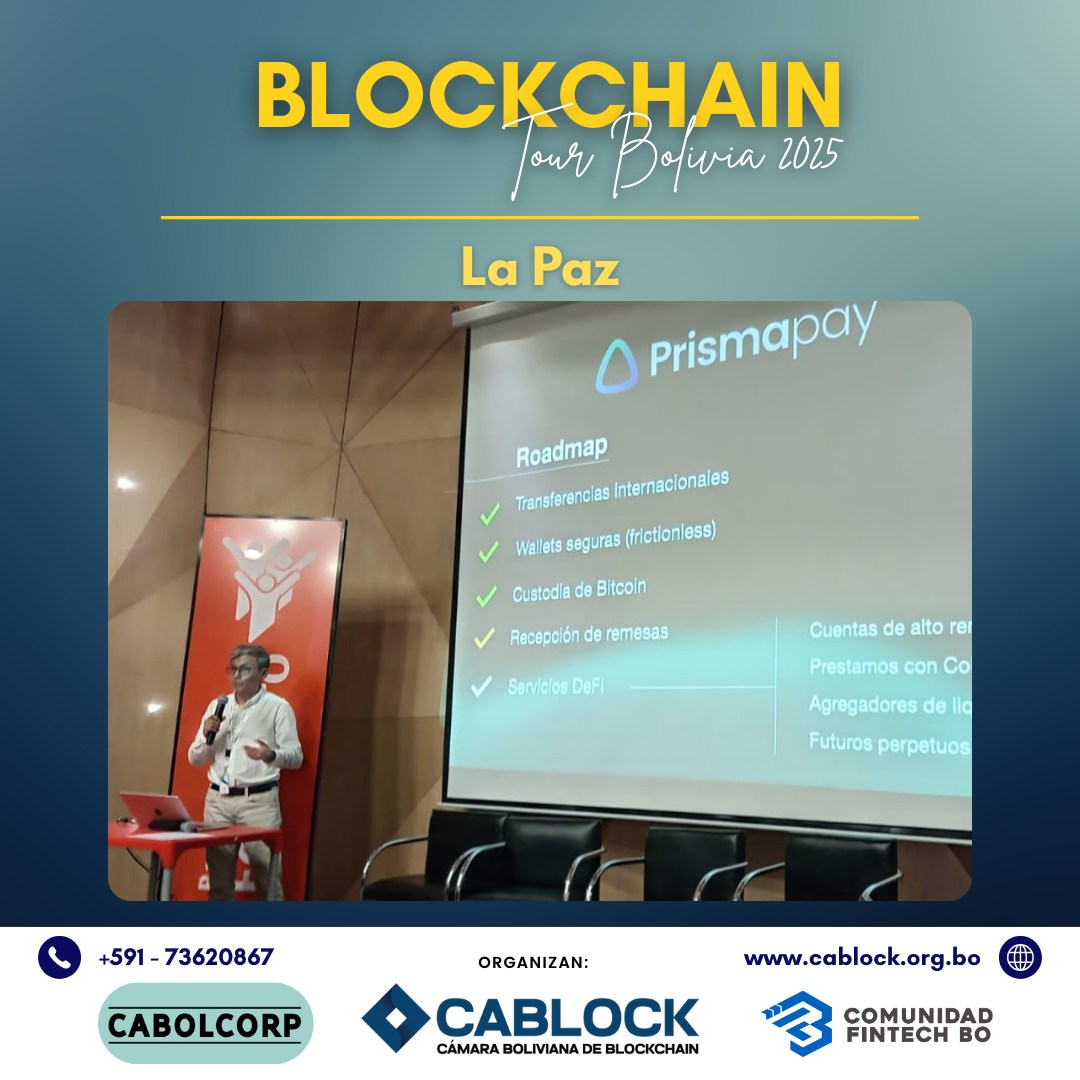
Blockchain technology is gaining traction in Bolivia. A growing number of users and developers are leveraging this new technology to solve problems and create opportunities in the country. This past Thursday, September 11th, the [Bolivian National Blockchain Chamber (CABLOCK)] concluded its Blockchain Tour Bolivia 2025, a national tour featuring symposia in Tarija, Santa Cruz, La Paz, and Cochabamba. The tour brought together national and international leaders in the crypto and Web3 ecosystem to discuss, teach, and build the country's digital future.
The auditoriums were packed with students, entrepreneurs, programmers, regulators, and technology enthusiasts who attended to understand the real opportunities offered by blockchain technology. Companies and organizations such as PrismaPay.net, Takenos, Blockfinity Advisors, Siscotec, Cabolcorp and Quantum Motors participated with presentations that addressed everything from solutions to the current economic situation to the regulatory and talent development challenges that Bolivia must face.
One of the most discussed topics was [tokenization] (https://www.sydle.com/es/blog/tokenizacion-65e8cd225d245147cf6e412e 'Un artículo sobre tokenización'). The panelists explained how this technology allows physical assets or rights—such as properties, vehicles, invoices, or contracts—to be represented as digital tokens registered on a blockchain. International examples were shown of tokenized real estate projects that allow the purchase of digital fractions of a property, agricultural exports divided into tokens to facilitate financing, and logistics chains in which each stage is recorded in a traceable and transparent manner. The experts agreed that this technology can transform strategic sectors of the Bolivian economy, reducing transaction costs, improving liquidity, and generating new investment instruments.
There was also enthusiastic discussion about the development of a [legal framework for cryptocurrencies in Bolivia]. The speakers agreed that national and international investors welcome the fact that the State has begun developing a regulatory framework to govern and oversee the use of cryptocurrencies in the country through the Financial System Supervisory Authority (ASFI). While current legal gaps raise some concerns, they also present unique opportunities to launch ventures and position Bolivia as a pioneer in the region, provided the new regulations balance legal certainty with the promotion of innovation. CABLOCK announced that it will promote joint working groups with public and private entities to contribute to this process.
Another key point was that of blockchain-based cross-border payment companies, an alternative that is becoming increasingly necessary given the shortage of dollars in the Bolivian banking system. The panelists demonstrated how fintech platforms use stablecoins—digital assets backed 1:1 by US dollars—to send international payments in minutes with minimal fees. While a traditional international bank transfer can take 3 to 7 days and cost between 2% and 7% of the amount, blockchain-based solutions reduce that time to minutes and those fees to less than 3%. This topic generated particular interest among importers and exporters in the audience, who face the limitations of the local banking system daily.
The tour also focused on blockchain talent development in Bolivia. Several panelists pointed out that the country has great human potential but needs specialized training programs and job placement opportunities in real-world projects. CABLOCK announced that it is working on agreements with universities and technology companies to create blockchain bootcamps, certifications, and development labs to train a new generation of Bolivian developers prepared for the global market.
Among all the presentations, the one that made the biggest impact was PrismaPay's in La Paz and Cochabamba, due to its technical and visionary approach. Its CTO, Kublai Gómez, delivered a presentation that combined scientific rigor and inspiration. He began by recounting the history of cryptography, from classical ciphers to the modern systems that protect our digital communications today. He clearly explained how blockchain is based on cryptographic algorithms such as RSA (Rivest–Shamir–Adleman) [https://www.youtube.com/watch?v=tZKuRkIrdtM 'RSA Cryptography Video'] and ECDSA (Elliptic Curve Cryptography) [https://www.youtube.com/watch?v=9mR_h9ufs4E 'A Short Video on Elliptic Curves'] to guarantee that transactions are authentic, secure, and immutable.
The most fascinating part came when he addressed the future: Gómez explained that quantum computing could render current algorithms vulnerable, especially RSA and elliptic curve algorithms, since quantum computers will be able to solve in minutes mathematical problems that would currently take millions of years. However, far from presenting this as a threat, he showed it as an opportunity: quantum computing will allow the development of new quantum-resistant encryption methods, capable of sustaining digital security in the next technological era.
Gómez's clarity and vision astonished the audience and demonstrated that PrismaPay has a highly technical, capable, and visionary team, prepared not only to use current technology but also to anticipate the challenges to come. Their presentation was one of the most talked-about moments of the tour and positioned PrismaPay as one of the Bolivian companies with the greatest potential in the region's blockchain and fintech sector.
The Blockchain Tour Bolivia 2025 demonstrated that Bolivia is no longer on the sidelines: it is beginning to build its own blockchain ecosystem with local talent, innovative companies, and a community determined to transform the country through technology. CABLOCK is thus consolidating its position as the driving force behind this movement, making it clear that Bolivia's digital future is already underway.
Laura Villegas