
For any company, exporter, or independent contractor billing overseas clients, receiving a payment should mark the finish line of a job well done. In traditional international banking, however, it is often where the biggest headaches begin: unexplained rejected transfers, endless compliance requests, or, in worst-case scenarios, the sudden closure of either the sending or receiving account.
The underlying cause behind most of these disruptions has a very specific technical name: third-party payments.
In this article, we explain what Virtual Accounts in your own name are, why banks in the United States and Europe enforce strict account ownership rules, and how this solution enables you to process significant amounts with full regulatory peace of mind.
The hidden issue: why US and European banks flag third-party deposits
Financial networks in the United States (ACH and Fedwire) and Europe (SEPA and TARGET2) operate under stringent Anti-Money Laundering (AML) and Counter-Terrorist Financing regulations.
Whenever an overseas partner, client, or institution initiates a wire transfer, automated compliance engines look for one critical rule: name matching.
If the sending bank detects that the destination bank account does not match the actual beneficiary’s name—or if funds are sent to an omnibus/pooled intermediary account where thousands of users share the same account details with a simple memo reference—red flags are triggered immediately:
- Frozen funds: Transfers are held for days or weeks while compliance teams demand invoices, service contracts, and proof of fund origins.
- Rejections and return fees: The funds are returned to the originating institution, often incurring outbound and return bank deductions.
- Preventative account closures: If recurring or high-value transfers are repeatedly routed to mismatched names, US and European institutions often choose to close the client's account outright to avoid regulatory scrutiny from agencies like FinCEN or the ECB.
What Virtual Accounts are and how they work
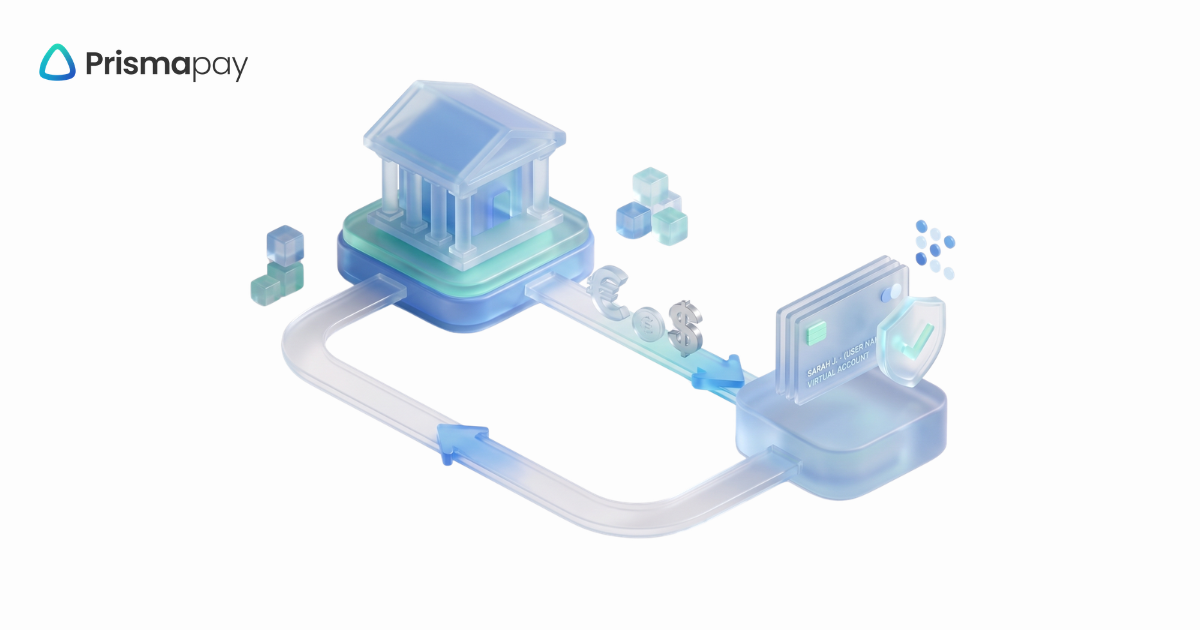
A Virtual Account (dedicated virtual account) is a banking endpoint issued through regulated fintech infrastructure that carries your legal personal or corporate name, accompanied by local banking details:
- For the United States: Your dedicated Routing Number (ABA) and Account Number to receive ACH and Fedwire transfers.
- For Europe: Your own dedicated IBAN to receive SEPA credit transfers.
In practice: to the sending bank in New York or Frankfurt, the transaction looks like a straightforward local bank transfer directly to the named beneficiary. There are no generic third-party entities, no confusing payment references, and no compliance red flags.
Collective accounts vs. Virtual Accounts in your name
Many traditional fintech services rely on omnibus or pooled setups: the user receives bank details registered under the generic payment processor's name and must explicitly ask the sender to include an alphanumeric reference code in the transfer memo field.
The friction here is frequent and operational: if the sender forgets to include the code, or if the sending bank truncates the memo field, the money arrives as an unidentified deposit. The platform receives the funds, but their automated ledger has no way of knowing which user or balance they belong to. This results in manual support tickets, sending transfer receipts back and forth, and waiting days for reconciliation teams to match the transfer manually.
With a Virtual Account in your name:
- You or your company are the legal beneficiary: The sending bank verifies your exact name in the account holder field.
- Automated reconciliation: Incoming deposits are instantly matched and credited without manual review.
-
High-volume capability: By eliminating third-party payment risks, you can handle large transactions smoothly without triggering automated fraud or unauthorized-party alerts.
Criterion Pooled / Third-Party Accounts Dedicated Virtual Accounts Account Holder Name of the third-party intermediary Your legal personal or corporate name US/EU Bank Risk High (compliance flags and closure risks) Minimal (fully aligned with name matching rules) Bank Details Shared account details + memo code Dedicated Routing/Account Number or IBAN High-Volume Support Restricted and heavily scrutinized Tailored for corporate workflows and large volumes Supported Rails Varies, subject to multi-tier hops Native USD (ACH / Wire) and EUR (SEPA)
Conclusion
Moving money internationally shouldn't mean constantly worrying whether a bank will flag, freeze, or return your funds. For businesses and professionals handling critical operations with the United States and Europe, having accounts directly in their own name is no longer optional—it is an operational necessity.
At Prismapay, we offer Virtual Accounts so you can receive USD and EUR deposits under your own name, combining the reliability of traditional banking rails with the agility of modern digital settlement. If you need to collect funds from abroad while protecting your banking reputation and avoiding account closures, let's talk.
Prismapay — corporate banking for your company.